Australian e-commerce businesses often rely on multiple systems to manage online orders, inventory, customers, products, accounting and fulfilment. As an online store grows, manually transferring information between an e-commerce platform and an ERP system can create delays, duplicate data and unnecessary administrative work.
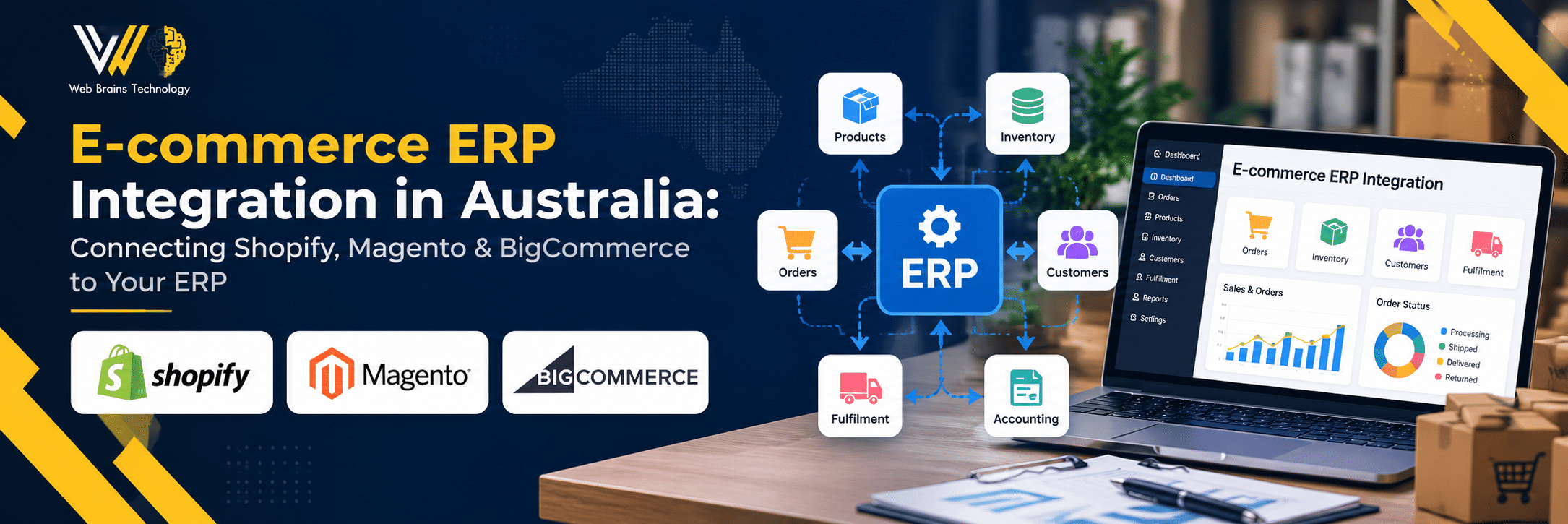
E-commerce ERP integration connects your online store with your ERP so important business data can move between systems more efficiently.
Whether your business operates on Shopify, Magento or BigCommerce, integration can help synchronise orders, inventory, product information, customer data and fulfilment processes while giving your team greater visibility across operations.
For Australian businesses managing increasing online sales, ERP integration can be an important step towards improving operational efficiency without replacing every system already in use.
What Is E-commerce ERP Integration?
E-commerce ERP integration is the process of connecting an e-commerce platform with an Enterprise Resource Planning (ERP) system.
Instead of maintaining separate information across your online store and back-office systems, an integration can allow relevant data to be exchanged between them.
Depending on the systems and integration architecture, this can include:
- Customer information
- Product data
- Stock levels
- Online orders
- Order status
- Pricing
- Product variations
- Shipping information
- Tax information
- Invoices
- Returns and refunds
- Fulfilment information
The exact data exchanged depends on the e-commerce platform, ERP, APIs, business processes and integration requirements.
Why Australian E-commerce Businesses Need ERP Integration
As an e-commerce operation grows, managing data manually becomes increasingly difficult.
For example, an Australian retailer may receive an order through Shopify while inventory is managed in an ERP and fulfilment is handled through another system.
Without appropriate integration, employees may need to manually transfer information between platforms.
This can result in:
- Duplicate data entry
- Inventory discrepancies
- Delayed order processing
- Incorrect product information
- Manual reconciliation
- Limited visibility across departments
- Increased operational workload
- Higher risk of human error
An integrated environment can reduce unnecessary manual processes and provide a more consistent flow of information.
Shopify ERP Integration Australia
Shopify ERP integration connects a Shopify store with an ERP or other business systems.
For Australian Shopify businesses, integration may be useful when order volumes increase or when inventory, accounting and fulfilment become difficult to manage through disconnected systems.
Common Shopify ERP integration requirements include:
- Shopify order synchronisation
- Product and SKU synchronisation
- Inventory updates
- Customer data synchronisation
- Pricing updates
- Order fulfilment updates
- Shipping information
- Returns and refund data
- Invoice information
For example, when a customer places an order through a Shopify store, the integration can transfer the relevant order information to the ERP for processing.
Australian businesses that require customised Shopify functionality can also work with experienced Shopify developers when their ERP integration involves custom workflows, API connections or tailored e-commerce functionality.
Shopify ERP integration can help businesses:
- Reduce manual order entry
- Improve inventory visibility
- Streamline fulfilment
- Reduce duplicate data
- Connect online sales with back-office operations
The integration should be designed around the actual business workflow rather than simply connecting every available data field.
Magento ERP Integration Australia
Magento, now part of Adobe Commerce, is commonly used for more complex e-commerce operations where businesses require extensive product, customer and commerce functionality.
Magento ERP integration can connect the store with an ERP to support the exchange of operational and commercial information.
Depending on requirements, an integration may synchronise:
- Products
- Product attributes
- Categories
- SKUs
- Inventory
- Customer accounts
- Orders
- Invoices
- Shipping information
- Returns
- Pricing
- Promotions
For businesses operating large product catalogues or multiple sales channels, keeping product and inventory information consistent can become particularly important.
A well-designed Magento ERP integration can help create a more connected workflow between the online storefront and internal business systems.
BigCommerce ERP Integration Australia
BigCommerce ERP integration connects a BigCommerce store with an ERP or other business applications.
This can be particularly useful for growing Australian businesses that need to coordinate online sales with inventory, fulfilment, accounting or warehouse operations.
Depending on the integration requirements, data may flow between BigCommerce and the ERP for:
- Orders
- Products
- Inventory
- Customers
- Pricing
- Shipping
- Fulfilment
- Returns
- Invoices
The integration architecture should account for the frequency and direction of data synchronisation.
For example, inventory information may need to flow from the ERP to BigCommerce, while new customer orders may flow from BigCommerce into the ERP.
What Data Can Be Synced Between an E-commerce Store and ERP?
The data required for integration differs between businesses.
However, common integration areas include the following.
1. Product Data
Product information can include:
- Product names
- SKUs
- Descriptions
- Categories
- Product variations
- Pricing
- Product attributes
Synchronising product information can reduce the need to update the same information manually in multiple systems.
2. Inventory
Inventory synchronisation is one of the most important requirements for many e-commerce businesses.
Stock levels can potentially be synchronised between the ERP and online store so customers see more accurate availability.
This becomes particularly important when products are sold through multiple channels.
3. Orders
Customer orders can be transferred from the e-commerce platform into the ERP for processing.
This may include:
- Customer details
- Products purchased
- Quantities
- Prices
- Discounts
- Shipping details
- Payment information
- Tax information
4. Customers
Customer information can potentially be synchronised between systems to reduce duplicate records and improve visibility.
5. Fulfilment and Shipping
Order status and fulfilment information can be transferred between systems so customers and internal teams have better visibility of order progress.
How Does E-commerce ERP Integration Work?
A typical integration can involve several components.
E-commerce Platform
This could be:
- Shopify
- Magento / Adobe Commerce
- BigCommerce
Integration Layer
An integration layer can manage communication between the e-commerce platform and ERP.
This may use:
- APIs
- Middleware
- Webhooks
- Custom integration services
- Scheduled synchronisation
- Event-driven workflows
ERP System
The ERP acts as a central business system for relevant operational information such as inventory, orders, financial processes or supply chain data.
Example Data Flow
A simplified order workflow can show how information moves between an e-commerce platform, integration layer and ERP system. The exact data flow depends on the platforms, ERP and business requirements.
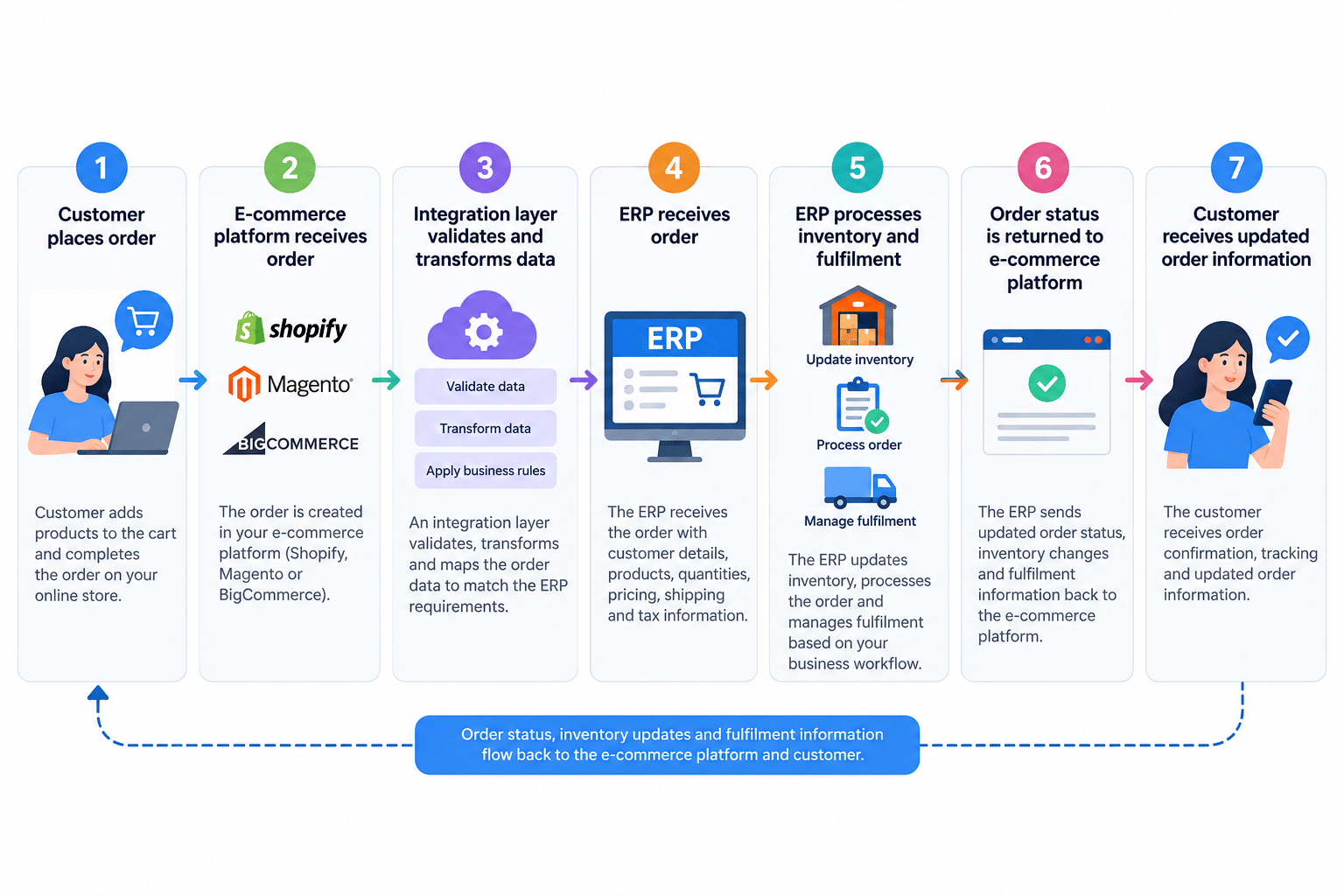
The actual architecture depends on the platforms, ERP and business requirements.
API-Based vs Middleware ERP Integration
There is no single integration architecture that works for every Australian e-commerce business.
Two common approaches are direct API integration and middleware-based integration.
Direct API Integration
A custom integration can connect the e-commerce platform directly with the ERP using APIs.
Potential advantages:
- Greater control
- Custom business logic
- Flexible data mapping
- Suitable for specialised workflows
Potential challenges:
- Development and maintenance requirements
- More responsibility for error handling
- API changes may require updates
Middleware Integration
Middleware sits between the e-commerce platform and ERP.
It can help manage:
- Data transformation
- Routing
- Authentication
- Error handling
- Synchronisation
- Multiple system connections
Middleware can become particularly useful when a business needs to connect several systems rather than only an e-commerce platform and ERP.
Common E-commerce ERP Integration Challenges
ERP integration is not simply a matter of connecting two APIs.
Businesses need to understand how their systems currently store and process information.
Data Mapping
The same information may use different field names or structures across systems.
For example, an e-commerce platform may use one SKU structure while the ERP uses another.
Inventory Synchronisation
Businesses need to determine which system is the source of truth for inventory.
Duplicate Records
Customer and product records can become duplicated if matching rules are not properly defined.
API Limitations
Platforms and ERP systems may have API limits, authentication requirements or different synchronisation capabilities.
Error Handling
An integration should have a way to identify and manage failed transactions.
Legacy Systems
Older ERP systems may require additional integration methods or custom middleware.
Security
Customer and business data should be transferred using appropriate authentication and security practices.
How Much Does E-commerce ERP Integration Cost in Australia?
There is no fixed price for ERP integration because every business has different systems and requirements.
The cost can depend on:
- E-commerce platform
- ERP platform
- Number of systems involved
- Number of data entities
- API availability
- Integration complexity
- Custom business rules
- Number of sales channels
- Inventory requirements
- Data migration requirements
- Testing requirements
- Ongoing maintenance
A simple integration between two systems may require significantly less work than a multi-system architecture involving an ERP, e-commerce platform, warehouse management system, payment platform and shipping software.
For this reason, Australian businesses should assess the required workflows and integrations before comparing development costs.
E-commerce ERP Integration Process
A structured integration process can help reduce implementation risks.
Step 1: Understand Business Requirements
Identify the systems currently being used and the processes that need to be connected.
Step 2: Map Data
Determine what information needs to move between systems and which system should be the source of truth.
Step 3: Review APIs and Integration Options
Assess the available APIs, middleware options and technical limitations of each platform.
Step 4: Design the Integration Architecture
Define how information will move between Shopify, Magento or BigCommerce and the ERP.
Step 5: Develop the Integration
Build the required connections, data transformations, business rules and workflows.
Step 6: Test the Integration
Test normal transactions as well as failed orders, incorrect data, duplicate records and other edge cases.
Step 7: Deploy and Monitor
After deployment, monitor synchronisation and resolve integration errors.
Step 8: Ongoing Support
E-commerce platforms and ERP systems change over time, so integrations may require maintenance and optimisation.
How to Choose an ERP Integration Partner in Australia
Choosing an integration partner should involve more than comparing development prices.
Look for a provider that can understand both the e-commerce workflow and the back-office business process.
Consider:
Experience With Your Platforms
Ask whether the provider has experience integrating your e-commerce platform and ERP.
API and Integration Expertise
The team should understand APIs, authentication, data mapping, webhooks and integration architecture.
Business Process Understanding
The integration should support how your business actually operates.
Testing and Error Handling
Ask how failed synchronisations and data errors will be identified and managed.
Scalability
The integration should be able to support business growth where practical.
Ongoing Support
Find out how updates, API changes and future integration requirements will be handled
When Should an Australian Business Consider ERP Integration?
ERP integration may be worth considering when:
- Order volume is increasing
- Staff manually enter orders into multiple systems
- Inventory information is frequently inconsistent
- Multiple sales channels are being used
- Product data is maintained in several systems
- Fulfilment processes are becoming difficult to manage
- Finance and e-commerce systems are disconnected
- The business is expanding into new sales channels
However, integration is not automatically the right solution for every business.
Before development begins, evaluate the existing systems, processes and expected business outcomes.
Benefits of E-commerce ERP Integration
A well-planned integration can help Australian businesses create a more connected technology environment.
Potential benefits include:
Reduced manual work
Automate repetitive data-transfer processes.
Better inventory visibility
Synchronise relevant stock information between systems.
Faster order processing
Move order information between the store and ERP more efficiently.
Improved data consistency
Reduce duplicate updates across multiple platforms.
Greater operational visibility
Connect e-commerce activity with internal business processes.
Scalable workflows
Build processes that can support increasing transaction volumes.
Final Thoughts
E-commerce ERP integration in Australia can help businesses connect their online stores with the systems responsible for inventory, orders, customers, fulfilment and other operational processes.
Whether you use Shopify, Magento or BigCommerce, the right integration approach depends on your ERP, existing technology stack and business workflows.
Rather than integrating every possible data field, start by identifying the processes creating the most manual work or operational problems. From there, a structured integration strategy can connect the systems that matter most while providing a foundation for future growth.
If your Australian e-commerce business is struggling with disconnected systems, manual order processing or inconsistent inventory data, ERP integration may provide a practical path towards a more connected operation.
Frequently Asked Questions
What is e-commerce ERP integration?
E-commerce ERP integration connects an online store such as Shopify, Magento or BigCommerce with an ERP system so relevant business data can be exchanged between the systems.
Can Shopify integrate with an ERP?
Yes. Shopify can be integrated with ERP systems using APIs, middleware or other integration approaches depending on the ERP and business requirements.
Can Magento integrate with an ERP?
Yes. Magento / Adobe Commerce can be connected to ERP systems to synchronise information such as products, orders, customers and inventory.
Can BigCommerce integrate with an ERP?
Yes. BigCommerce can be integrated with ERP systems using APIs and other integration technologies, depending on the systems involved.
What information can be synchronised?
Depending on the integration, businesses may synchronise products, inventory, orders, customers, pricing, fulfilment, shipping and other operational information.
How much does ERP integration cost in Australia?
The cost depends on the platforms, number of systems, data requirements, integration complexity, custom workflows, testing and ongoing support requirements.
Do I need to replace my ERP to integrate with my e-commerce platform?
Not necessarily. If your existing ERP provides suitable integration capabilities, it may be possible to connect it with your e-commerce platform without replacing the ERP.
How long does e-commerce ERP integration take?
Implementation time varies depending on the number of systems, data flows, APIs, custom requirements and testing needed. A proper technical assessment should be completed before providing a project timeline.
Can I connect multiple e-commerce platforms to one ERP?
Yes. Depending on the ERP and integration architecture, multiple e-commerce platforms can potentially connect to a single ERP. The integration needs to account for data mapping, inventory rules, order workflows and the source of truth for each system.