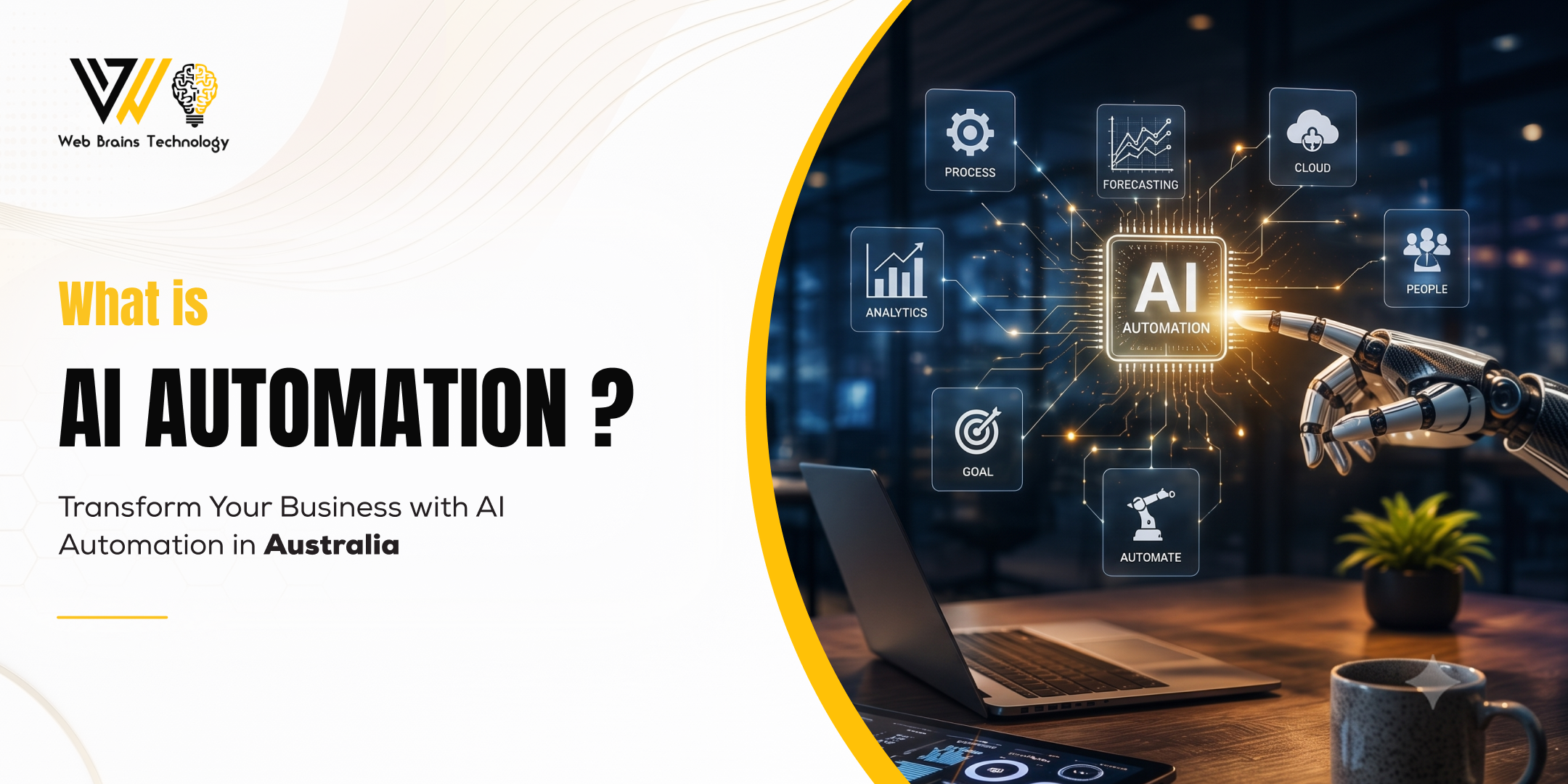
Artificial Intelligence (AI) is no longer a futuristic concept—it has become a practical business tool that is transforming how organisations operate. Across Australia, businesses of every size are embracing AI automation to eliminate repetitive tasks, improve productivity, enhance customer experiences, and make smarter decisions using real-time data.
Whether you’re a startup looking to automate customer support, an eCommerce retailer aiming to streamline order processing, or a large enterprise modernising legacy workflows, AI automation can help your business work faster, smarter, and more efficiently.
Unlike traditional automation, which follows fixed rules and predefined workflows, AI automation combines machine learning, natural language processing (NLP), computer vision, and predictive analytics to analyse data, understand context, and make intelligent decisions. This allows businesses to automate more complex processes that previously required human judgement.
According to industry reports, Australian organisations are rapidly increasing investment in AI technologies to remain competitive, reduce operational costs, and improve customer satisfaction. As AI capabilities continue to evolve, automation is becoming a strategic necessity rather than a competitive advantage.
In this guide, you’ll learn:
- What AI automation is and why it matters
- How AI automation works
- Different types of AI automation
- Real-world AI automation examples
- Business benefits for Australian organisations
- The future of AI-powered business automation
Whether you’re exploring AI for the first time or planning your digital transformation strategy, this guide will help you understand how AI automation can create measurable business value.
What Is AI Automation?
AI automation is the use of artificial intelligence technologies to automate business processes, repetitive tasks, and decision-making activities with minimal human intervention.
Instead of simply following a predefined sequence of rules, AI-powered systems can analyse information, recognise patterns, learn from historical data, and continuously improve their performance over time.
For example:
- Automatically responding to customer enquiries using AI chatbots.
- Reading and processing invoices without manual data entry.
- Predicting customer demand before inventory runs low.
- Routing support tickets based on urgency and sentiment.
- Detecting fraudulent financial transactions in real time.
This makes AI automation far more flexible than conventional automation software.
Traditional Automation vs AI Automation
Traditional automation works best when every step follows predictable rules. If a process changes or an unexpected scenario occurs, human intervention is often required.
AI automation, on the other hand, can adapt to changing conditions by analysing data and making informed decisions. It can understand language, recognise images, predict future outcomes, and continuously optimise workflows based on new information.
This capability allows Australian businesses to automate complex operations while improving speed, accuracy, and customer experiences.
Key Technologies Behind AI Automation
Several advanced technologies work together to power modern AI automation solutions.
Machine Learning (ML)
Machine learning enables AI systems to identify patterns within large datasets and improve performance without being explicitly programmed for every scenario.
Examples include:
- Sales forecasting
- Customer behaviour prediction
- Product recommendations
- Demand planning
Natural Language Processing (NLP)
Natural Language Processing allows computers to understand and respond to human language.
Businesses commonly use NLP for:
- AI chatbots
- Email automation
- Virtual assistants
- Document analysis
- Customer support
Computer Vision
Computer vision enables machines to interpret images and videos.
Common applications include:
- Manufacturing quality inspections
- Warehouse inventory management
- Identity verification
- Medical image analysis
Predictive Analytics
Predictive analytics uses historical data and AI models to forecast future outcomes.
Businesses use predictive analytics for:
- Sales forecasting
- Customer retention
- Risk management
- Fraud detection
- Inventory optimisation
Intelligent Decision-Making
Modern AI automation platforms combine multiple AI technologies to recommend or execute decisions automatically based on business rules and real-time information.
This reduces manual effort while improving operational efficiency.
How Does AI Automation Work?
AI automation follows a structured process that transforms raw business data into intelligent actions.
Understanding this workflow helps businesses identify where automation can deliver the greatest value.
Step 1: Collect Business Data
Every AI automation system begins by collecting information from multiple sources, including:
- CRM platforms
- ERP systems
- Accounting software
- Emails
- Customer support platforms
- Websites
- IoT devices
- Cloud applications
The quality of this data directly impacts the accuracy of AI-generated insights.
Step 2: Process and Analyse Information
AI algorithms analyse the collected data to identify trends, relationships, and patterns that would be difficult for humans to detect manually.
For example, an AI system might identify:
- Customers likely to cancel subscriptions.
- Products with increasing demand.
- High-risk financial transactions.
- Frequently asked customer questions.
Step 3: Make Intelligent Decisions
Unlike traditional software, AI evaluates multiple variables before selecting the most appropriate action.
Examples include:
- Prioritising urgent support tickets.
- Automatically approving invoices.
- Recommending products.
- Assigning sales leads.
- Detecting fraud.
Step 4: Automate Business Actions
Once a decision has been made, AI can trigger automated workflows such as:
- Sending emails
- Updating CRM records
- Creating invoices
- Scheduling appointments
- Processing customer requests
- Escalating support cases
This significantly reduces manual administration while increasing consistency.
Step 5: Learn and Improve
One of AI automation’s greatest strengths is continuous learning.
As more data becomes available, AI models improve their predictions, recommendations, and decision-making capabilities over time.
This means your automation becomes smarter and more accurate as your business grows.
Types of AI Automation
AI automation can be applied across nearly every business function. The right solution depends on your goals, industry, and operational requirements.
Customer Service Automation
AI-powered chatbots and virtual assistants provide instant responses to customer enquiries, helping businesses deliver 24/7 support while reducing response times.
Common use cases include:
- Live chat
- Appointment bookings
- FAQ responses
- Ticket routing
- Customer onboarding
Sales Automation
Sales teams use AI automation to manage repetitive administrative tasks, allowing representatives to focus on building customer relationships.
Examples include:
- Lead scoring
- Sales forecasting
- CRM updates
- Meeting scheduling
- Proposal generation
Marketing Automation
AI enables marketers to create personalised customer experiences at scale.
Marketing automation includes:
- Email campaigns
- Audience segmentation
- Content recommendations
- Advertising optimisation
- Social media scheduling
Finance Automation
Finance departments use AI to improve efficiency and reduce human error.
Typical applications include:
- Invoice processing
- Expense management
- Financial reporting
- Fraud detection
- Payment reconciliation
HR Automation
Human Resources teams increasingly rely on AI to streamline hiring and employee management.
Examples include:
- Resume screening
- Candidate matching
- Employee onboarding
- Leave management
- Workforce analytics
Operations Automation
Businesses can automate operational workflows to improve productivity and reduce costs.
Examples include:
- Inventory management
- Supply chain optimisation
- Workflow approvals
- Asset tracking
- Production scheduling
Why AI Automation Matters for Australian Businesses
Australian businesses operate in an increasingly competitive environment where customers expect faster service, personalised experiences, and consistent quality.
AI automation helps organisations meet these expectations by reducing repetitive work, improving decision-making, and enabling employees to focus on higher-value activities.
Whether you’re a small business looking to automate daily administrative tasks or an enterprise modernising complex operations, AI automation provides a scalable pathway to greater efficiency, innovation, and long-term growth.
In the next section, we’ll explore real-world examples of AI automation across industries, the key benefits for Australian businesses, and how organisations are using AI to gain a competitive advantage.
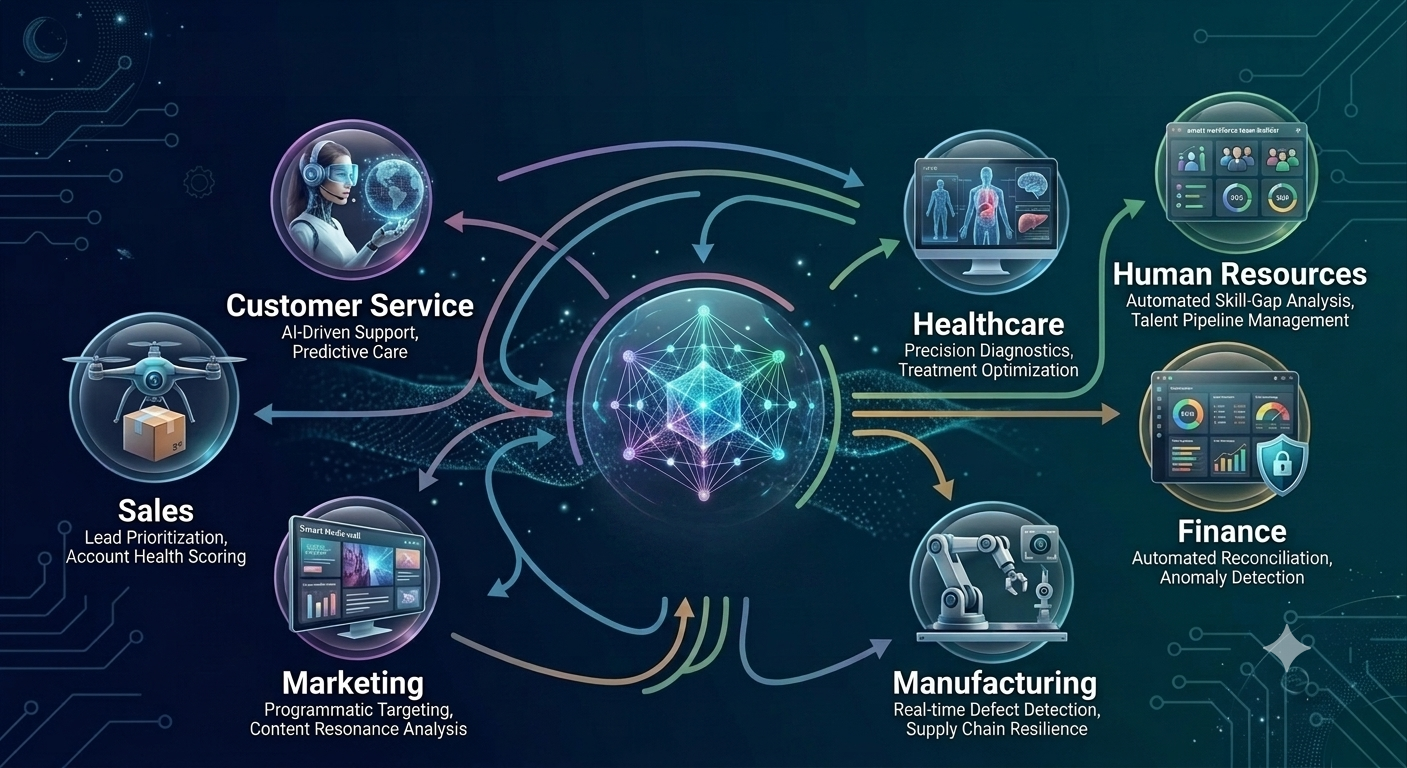
Real Examples of AI Automation Across Industries
Customer Service:
Customer expectations have changed significantly over the past few years. Today’s customers expect instant responses, personalised interactions, and support outside standard business hours.
AI-powered chatbots and virtual assistants help businesses deliver consistent customer service by:
- Answering frequently asked questions instantly
- Providing order and delivery updates
- Booking appointments automatically
- Routing complex enquiries to the right team
- Supporting customers 24/7
Sales:
Sales professionals spend a considerable amount of time on administrative work instead of building customer relationships.
AI business automation can streamline sales processes by:
- Scoring leads based on buying intent
- Automatically updating CRM records
- Scheduling follow-up emails
- Predicting sales opportunities
- Generating personalised proposals
Marketing:
Modern marketing relies heavily on data. AI automation helps marketing teams analyse customer behaviour and deliver personalised campaigns at scale.
Marketing automation can include:
- Personalised email marketing
- Customer segmentation
- Product recommendations
- Social media scheduling
- Content recommendations
- Campaign performance analysis
Finance:
Financial operations often involve repetitive manual tasks that consume valuable time and increase the risk of human error.
AI automation can simplify finance processes by:
- Processing invoices
- Matching payments
- Detecting fraudulent transactions
- Forecasting cash flow
- Automating expense approvals
- Generating financial reports
Human Resources:
Recruitment and employee management involve numerous repetitive administrative activities.
AI workflow automation helps HR teams by:
- Screening resumes
- Matching candidates to job descriptions
- Scheduling interviews
- Managing employee onboarding
- Answering HR-related questions through AI assistants
Healthcare:
Healthcare providers use AI automation to improve patient care while reducing administrative workloads.
Applications include:
- Appointment scheduling
- Medical record management
- Diagnostic assistance
- Prescription processing
- Patient follow-up reminders
Manufacturing:
Manufacturers are adopting AI automation to improve production quality and operational efficiency.
Common applications include:
- Predictive maintenance
- Quality inspections
- Inventory management
- Production planning
- Supply chain optimisation
What Are the Benefits of AI Automation?
AI automation delivers measurable benefits across every department of an organisation. Whether you’re a small business or a large enterprise, implementing AI automation can significantly improve operational performance.
Increased Productivity
One of the biggest advantages of AI automation is its ability to eliminate repetitive manual tasks.
Employees spend less time on administrative work and more time on strategic initiatives that drive business growth.
Examples include:
- Automated data entry
- Document processing
- Email management
- Workflow approvals
- Report generation
Lower Operating Costs
Manual processes require significant labour and often result in inefficiencies.
AI automation reduces operational costs by:
- Minimising repetitive work
- Reducing overtime
- Improving resource allocation
- Preventing costly errors
- Increasing workflow efficiency
For many Australian businesses, AI automation delivers long-term cost savings while supporting business growth.
Improved Accuracy
Human errors are inevitable, particularly when handling large volumes of repetitive work.
AI automation improves accuracy by consistently following predefined workflows while analysing data in real time.
This is particularly valuable for:
- Finance
- Healthcare
- Legal services
- Logistics
- Insurance
Faster Decision-Making
AI systems can analyse thousands of data points within seconds, providing actionable insights that help businesses make informed decisions more quickly.
Examples include:
- Sales forecasting
- Inventory optimisation
- Customer behaviour analysis
- Risk assessment
- Business intelligence reporting
Better Customer Experience
Customers expect fast, personalised, and reliable service.
AI automation helps businesses deliver the following:
- Instant support
- Personalised recommendations
- Faster response times
- Accurate information
- Consistent communication
Improved customer experiences often lead to stronger loyalty, higher retention rates, and increased revenue.
Scalability
As businesses grow, manual processes become increasingly difficult to manage.
AI automation allows organisations to scale operations without proportionally increasing staffing costs.
Whether processing hundreds or thousands of customer requests daily, AI automation maintains consistent performance.
Smarter Business Insights
AI analyses historical and real-time data to identify patterns that support strategic planning.
Businesses gain insights into:
- Customer purchasing behaviour
- Sales performance
- Marketing effectiveness
- Inventory trends
- Operational bottlenecks
These insights help leaders make more informed business decisions.
AI Automation vs RPA vs BPA vs Intelligent Automation vs Agentic AI
As businesses explore digital transformation, it’s common to come across terms like Robotic Process Automation (RPA), Business Process Automation (BPA), Intelligent Automation (IA), and Agentic AI. While these technologies are related, they solve different business challenges.
Understanding the differences helps Australian businesses choose the right automation strategy.
| Technology | Best For | Uses AI? | Learns from Data? |
| Business Process Automation (BPA) | Automating end-to-end business workflows | No | No |
| Robotic Process Automation (RPA) | Repetitive rule-based tasks | No | No |
| AI Automation | Intelligent decision-making and data analysis | Yes | Yes |
| Intelligent Automation (IA) | Combining AI with RPA for smarter workflows | Yes | Yes |
| Agentic AI | Autonomous AI systems that plan, reason and execute tasks | Yes | Continuously |
How to Build an AI Automation in Make
Make (formerly Integromat) is a visual automation platform that allows businesses to connect applications and create AI-powered workflows without extensive coding.
Below is a practical framework for building an AI automation.
Step 1: Identify a Repetitive Business Process
Choose a process that consumes time and follows a repeatable workflow.
Examples include:
- Lead qualification
- Customer enquiry responses
- Invoice processing
- Appointment scheduling
- Document generation
Step 2: Connect Your Applications
Integrate your business tools such as:
- CRM
- Email platform
- Google Workspace
- Microsoft 365
- Accounting software
- Slack
- HubSpot
- Shopify
- Salesforce
Step 3: Add an AI Model
Connect an AI model capable of handling natural language, summarisation, classification, or content generation.
Common use cases include:
- Email summarisation
- Customer sentiment analysis
- Lead qualification
- Proposal generation
- FAQ responses
Step 4: Build the Workflow
Create automation scenarios using triggers and actions.
Example:
Customer enquiry submitted
AI analyses the enquiry
Classifies request
Creates CRM record
Assigns team member
Sends personalised response
Notifies sales team
Step 5: Test and Optimise
Before deployment:
- Test multiple scenarios.
- Check data accuracy.
- Monitor workflow performance.
- Optimise prompts.
- Improve response quality.
AI automation performs best when continuously monitored and refined.
Which AI Is Best for Automation?
There is no single AI platform that suits every organisation. The best solution depends on your business goals, existing technology stack, budget, and automation requirements.
Here are some of the leading AI platforms used by businesses:
OpenAI
Best for:
- Customer support
- Content generation
- AI assistants
- Knowledge management
- Workflow automation
Microsoft Copilot
Best for:
- Microsoft 365 users
- Enterprise productivity
- Document automation
- Internal knowledge search
Google Gemini
Best for:
- Google Workspace
- Data analysis
- Research
- Productivity workflows
Anthropic Claude
Best for:
- Long-document processing
- Policy analysis
- Knowledge management
- Enterprise documentation
Zapier AI
Best for:
- Quick automation
- CRM integration
- Marketing workflows
- Productivity automation
When selecting an AI automation platform, consider:
- Ease of integration
- Security
- Scalability
- Customisation
- Compliance
- Ongoing support
- Total cost of ownership
What’s Next: Agentic AI Automation
The future of business automation is moving beyond simple workflows toward autonomous AI systems capable of managing complex objectives.
Agentic AI will enable businesses to automate end-to-end operations that currently require multiple people and software systems.
Future capabilities may include:
- Automatically planning marketing campaigns.
- Managing procurement processes.
- Coordinating customer support.
- Analysing business performance.
- Optimising inventory levels.
- Scheduling resources.
- Recommending strategic business actions.
Instead of asking AI to complete one task at a time, businesses will increasingly assign objectives, allowing AI to determine the most effective way to achieve them while keeping human oversight in place.
Australian organisations investing in AI today will be well positioned to adopt these next-generation capabilities as they mature.
Final Thoughts
AI automation is no longer limited to large enterprises with extensive technology budgets. Businesses of all sizes across Australia are using AI to streamline operations, improve customer experiences, reduce costs, and increase productivity.
Whether you’re beginning with a simple customer support chatbot or implementing intelligent workflows across multiple departments, the key to success is identifying high-impact processes and introducing automation strategically.
By combining the right AI tools with well-designed workflows and quality data, organisations can unlock measurable efficiency gains while creating more time for innovation and growth.
As AI technology continues to evolve, businesses that embrace automation today will be better prepared for the next generation of intelligent, autonomous operations.
Ready to Transform Your Business with AI Automation?
Looking to automate repetitive tasks, improve operational efficiency, or integrate AI into your existing business systems?
Our AI automation specialists help Australian businesses design, implement, and optimise tailored AI solutions that deliver measurable results.
Whether you need workflow automation, AI-powered customer support, document processing, CRM automation, or enterprise AI integration, we can help you build scalable solutions that support long-term growth.
Contact us today to discover how AI automation can help your business save time, reduce costs, and stay ahead of the competition.
Frequently Asked Questions
What is AI automation?
AI automation combines artificial intelligence with workflow automation to perform tasks, analyse data, make decisions, and continuously improve business processes with minimal human intervention.
How does AI automation work?
AI automation collects data, analyses it using AI models, makes intelligent decisions, and triggers automated actions across connected business systems.
What industries benefit from AI automation?
Healthcare, finance, retail, manufacturing, construction, education, logistics, professional services, real estate, and eCommerce all use AI automation to improve efficiency and customer experiences.
Is AI automation suitable for small businesses?
Yes. Many affordable AI automation platforms allow small and medium-sized businesses to automate repetitive tasks without significant upfront investment.
What is the difference between AI automation and RPA?
RPA automates repetitive rule-based tasks, while AI automation can understand information, learn from data, and make intelligent decisions.
Is AI automation secure?
When implemented correctly with appropriate security controls and compliance measures, AI automation can securely process business data and support regulatory requirements.
How much does AI automation cost in Australia?
Costs vary depending on business size, automation complexity, software licensing, and implementation requirements. Many businesses start with small automation projects and expand over time.
Does AI automation replace employees?
AI automation is designed to automate repetitive tasks, allowing employees to focus on higher-value work such as customer engagement, strategy, creativity, and decision-making.
What is Agentic AI?
Agentic AI is an advanced form of AI capable of planning, reasoning, and completing multi-step objectives with minimal human intervention, representing the next evolution of intelligent business automation.