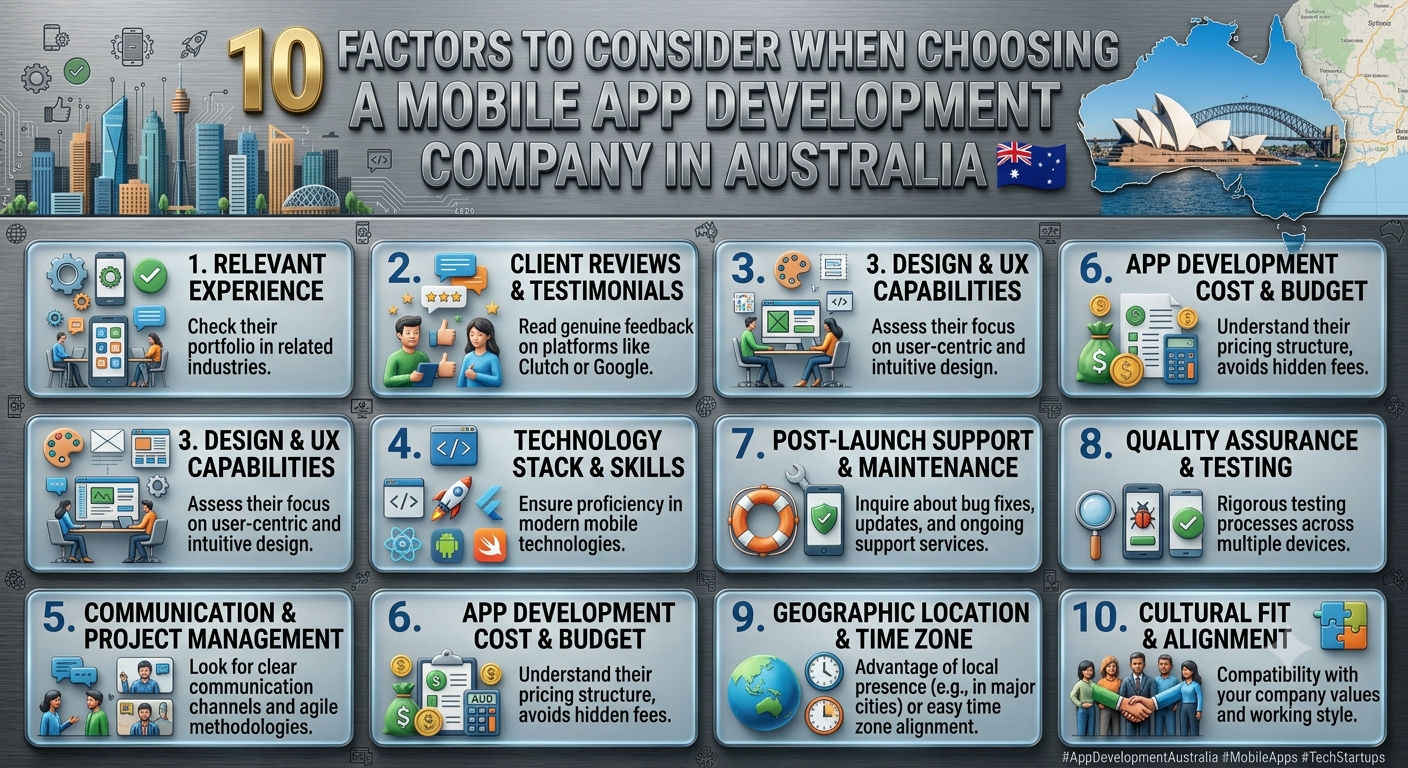

10 Factors to Consider When Choosing a Web Development Company in Australia

Choosing the right Web Development Company In Australia is an important decision for any business planning a new website, redesign, eCommerce platform or custom web application. The development partner you select can influence your website’s performance, security, scalability, user experience and long-term maintenance.

With Australian web development companies offering different technologies, pricing models and levels of expertise, comparing providers based only on price or portfolio design can make the decision difficult.

A better approach is to evaluate each company against practical factors such as technical expertise, relevant experience, development process, communication, SEO, security, pricing and post-launch support.

The 10 key factors to consider when choosing a web development company in Australia are relevant experience, technical expertise, portfolio quality, development process, SEO and performance, security, scalability, communication, pricing and post-launch support. 

1. Relevant Web Development Experience

Start by looking at the company’s experience with projects similar to yours.

A company may have extensive web development experience, but that does not necessarily mean it has worked with the requirements of your business or industry.

Consider whether the development company has experience with:

  • Business websites
  • eCommerce websites
  • Custom web applications
  • WordPress development
  • WooCommerce development
  • Shopify development
  • API integrations
  • CRM and third-party integrations
  • Enterprise web applications
  • Website migrations and redesigns

Ask potential providers for examples of projects with similar functionality, technology or business requirements.

Relevant experience can help a development team understand common technical challenges before development begins.

2. Technical Expertise and Technology Stack

The technology used to build your website should match your business requirements rather than simply following the latest trend.

Depending on the project, you may need technologies and platforms such as:

  • WordPress
  • WooCommerce
  • Shopify
  • PHP
  • Laravel
  • React
  • Node.js
  • APIs
  • Cloud platforms
  • Custom databases

A professional web development company should be able to explain why a particular technology stack is suitable for your project.

For example, a small business website may have very different requirements from an enterprise platform that needs multiple integrations, user accounts and complex business workflows.

Before signing a contract, ask:

Which technologies will you use, and why are they suitable for my website?

The answer should relate to your requirements, scalability, performance, security and future maintenance.

3. Portfolio and Relevant Case Studies

A portfolio can provide useful evidence of a company’s development capabilities.

However, don’t evaluate a portfolio only by looking at how attractive the websites appear.

Look at the underlying project requirements.

Check whether previous websites demonstrate:

  • Responsive design
  • Good navigation
  • Fast loading
  • Mobile usability
  • Custom functionality
  • eCommerce features
  • Third-party integrations
  • Clear calls to action
  • Search-friendly website structures

If possible, review live websites from the company’s portfolio on both desktop and mobile devices.

Case studies can also help you understand the problem the developer solved, the technology used and the development approach.

4. Development Process and Project Management

A structured development process can make a complex website project easier to manage.

Before choosing a company, ask how the project will move from the initial requirement through to launch.

A typical web development process may include:

Requirement Gathering → Planning → UI/UX Design → Development → Testing → Deployment → Post-Launch Support

Ask the company:

  • How are project requirements documented?
  • Who manages the project?
  • How often will progress be reported?
  • How will you provide feedback?
  • How are revisions handled?
  • How are additional requirements managed?
  • What happens if the project timeline changes?

A clear process helps both the business and development team understand responsibilities, milestones and deliverables.

5. Website SEO, Performance and Mobile Responsiveness

Web development and SEO should not be treated as completely separate activities.

The technical structure created during development can affect how search engines crawl, understand and access your website.

When evaluating a web development company, ask whether the development process considers:

  • Mobile responsiveness
  • Website speed
  • Core Web Vitals
  • Metadata implementation
  • Image optimisation
  • Internal linking
  • Structured data where appropriate
  • XML sitemaps
  • Crawlability
  • Indexability
  • Redirect management

The website should also provide a consistent experience across smartphones, tablets and desktop devices.

For Australian businesses competing in organic search, building a technically sound website from the beginning can reduce the need for major SEO-related redevelopment later.

6. Website Security and Data Protection

Security should be considered during development rather than only after a website has been launched.

Depending on the type of website, security requirements can include:

  • SSL/HTTPS
  • Secure authentication
  • Regular software updates
  • Secure API integrations
  • Access control
  • Protection against common web vulnerabilities
  • Secure payment processing
  • Database security
  • Regular backups

If your website collects customer information, processes payments or connects with business systems, discuss security requirements before development starts.

Ask the development company how it handles security testing, updates, backups and access permissions.

7. Scalability and Future Development

Your website may need to grow as your business grows.

A website that works for a small number of products, customers or users today may require additional functionality in the future.

Before choosing a development company, consider whether the proposed solution can accommodate:

  • Additional products or services
  • More website traffic
  • New integrations
  • Additional users
  • New payment methods
  • CRM integrations
  • Marketing automation
  • Mobile applications
  • New business workflows

Ask:

Can this website architecture support our expected growth over the next few years?

A development partner should be able to explain the scalability considerations of the proposed solution.

8. Communication and Support

Good communication is an important part of managing a web development project.

Before starting, establish how you will communicate with the development team and how frequently you will receive updates.

Ask about:

  • Project management tools
  • Email and messaging channels
  • Scheduled meetings
  • Development updates
  • Response times
  • Issue escalation
  • Technical support
  • Post-launch communication

For Australian businesses working with development teams in different locations, also consider time-zone compatibility and availability during Australian business hours.

Clear communication can help reduce misunderstandings about requirements, deadlines and project changes.

9. Pricing, Scope and Contract Terms

Price is an important consideration, but the cheapest proposal may not provide the same scope or level of service as a higher-priced proposal.

Instead of comparing only the final price, compare what each proposal includes.

Look for details such as:

Area What to Check
Design Custom design or template-based design?
Development Which functionality is included?
Integrations Are APIs, CRM or third-party systems included?
Testing What testing is performed before launch?
Hosting Is hosting included or separate?
SEO What technical SEO work is included?
Content Who provides and uploads content?
Revisions How many revision rounds are included?
Support What support is provided after launch?
Ownership Who owns the website, code and assets?

Also clarify whether the project is fixed-price, milestone-based or charged hourly.

A detailed proposal makes it easier to compare development companies on scope rather than price alone.

10. Post-Launch Maintenance and Support

Website development does not necessarily end when the website goes live.

Websites may require ongoing maintenance, security updates, performance improvements, bug fixes and new functionality.

Ask potential development partners what happens after launch.

Post-launch services may include:

  • Website maintenance
  • Security updates
  • Bug fixes
  • Performance optimisation
  • Backup management
  • Software updates
  • Technical support
  • Feature enhancements
  • Third-party integration support
  • Ongoing development

Understanding the available support before signing the development agreement can help you plan for the long-term cost of managing your website.

Questions to Ask a Web Development Company Before Hiring

Before selecting a development partner, consider asking:

  1. Have you developed websites similar to ours?
  2. Which technology stack do you recommend for our project?
  3. Can we review relevant case studies or live websites?
  4. What is included in the development scope?
  5. How long is the expected development timeline?
  6. Who will work on our project?
  7. How will project communication and updates work?
  8. How do you approach website security?
  9. How do you consider SEO and website performance during development?
  10. Who owns the website source code and assets?
  11. What happens if we need additional functionality?
  12. What support is available after launch?

The answers can help you compare different providers more consistently.

Web Development Company vs Freelancer: Which Should You Choose?

The right option depends on your project’s complexity, technical requirements, budget and expected level of ongoing support. Businesses should compare these factors alongside the developer’s experience, communication process and ability to support the project over time. 

Consider:

Requirement Freelancer Web Development Company
Small website May be suitable May be suitable
Complex integrations Depends on expertise Often involves multiple specialists
Large development team Limited Typically available
Long-term development Depends on availability Can provide ongoing resources
Project management May be handled by developer Often dedicated project management
Enterprise requirements Depends on capability Can support larger team structures

The decision should be based on project complexity, technical requirements, budget and the level of ongoing support required.

How Much Does Web Development Cost in Australia?

The cost of developing a website in Australia can vary significantly depending on the project’s requirements.

Factors that can influence development costs include:

  • Website size
  • Design complexity
  • Number of pages
  • Custom functionality
  • eCommerce requirements
  • API integrations
  • CRM integrations
  • Payment gateways
  • User accounts
  • Content management requirements
  • Testing requirements
  • Ongoing maintenance

Rather than asking only How much does a website cost?, ask for a detailed proposal that explains the scope, deliverables, development timeline and ongoing costs.

This makes it easier to understand what you are actually paying for.

Red Flags to Watch For When Choosing a Web Development Company

Before signing an agreement, watch for potential warning signs such as:

  • No relevant portfolio or case studies
  • Unclear project scope
  • Extremely vague pricing
  • No defined development process
  • No testing process
  • Unclear ownership of the website or source code
  • No post-launch support options
  • Unrealistic delivery promises
  • Poor communication
  • Limited explanation of the recommended technology

These issues do not automatically mean a company is unsuitable, but they are reasons to ask additional questions before committing to a project.

Web Development Checklist for Australian Businesses

Use this checklist when comparing web development companies:

  • Relevant development experience
  • Suitable technology expertise
  • Strong portfolio and case studies
  • Clear development process
  • Mobile-responsive development
  • SEO-friendly technical foundation
  • Website security considerations
  • Scalable architecture
  • Clear communication process
  • Transparent project scope and pricing
  • Clear ownership terms
  • Post-launch support

A provider that can clearly address these areas gives you more information to evaluate before making your decision.

Web Development Support for Australian Businesses 

Webbrains helps businesses develop websites and custom digital solutions based on their specific requirements.

Our capabilities include custom web development, eCommerce development, front-end development, back-end development, API development and full-stack development.

We begin by understanding the project’s business and technical requirements before recommending an appropriate development approach. This helps businesses identify the right technology, functionality and development process for their website or web application.

If you’re planning a new website, redesign or custom web application, explore our web development services to learn more about our approach, development capabilities and available solutions for Australian businesses. 

Final Thoughts

Choosing a web development company in Australia requires more than comparing website designs or selecting the lowest quote.

Look at the company’s relevant experience, technical capabilities, portfolio, development process, SEO and performance approach, security practices, communication, pricing structure, scalability and post-launch support.

Most importantly, make sure

the company understands your business requirements and can explain how its proposed solution will support your current needs and future growth.

By comparing these factors before signing a contract, Australian businesses can make a more informed decision and establish clearer expectations for the development project.

Frequently Asked Questions


How do I choose a web development company in Australia?

Start by defining your website requirements, then compare companies based on relevant experience, technical expertise, portfolio, development process, pricing, communication, security and post-launch support.

How much does web development cost in Australia?

Web development costs vary depending on the website’s size, functionality, technology, integrations, design requirements and ongoing support. Request a detailed proposal rather than comparing only headline prices.

What should I ask a web development company before hiring?

Ask about relevant projects, technology recommendations, project scope, timeline, development process, SEO, security, ownership, communication, pricing and post-launch support.

Should I choose a freelancer or a web development company?

The appropriate option depends on your project’s complexity, technical requirements, budget and need for ongoing support. Smaller projects may have different requirements from complex websites or custom applications.

Why is SEO important during web development?

SEO considerations such as mobile responsiveness, website performance, crawlability, URL structure and technical implementation can be incorporated during development, helping create a stronger technical foundation for future organic search activity.

What should be included in a web development proposal?

A proposal should clearly explain the project scope, deliverables, technology, timeline, pricing, integrations, testing, ownership terms, revisions and post-launch support.

Hire Shopify Expert Developers in Australia Without Costly Ecommerce Mistakes

Choosing the right Shopify developer can have a major impact on the success of your e-commerce business. A developer may be responsible for your store’s design implementation, custom functionality, integrations, performance, security and ongoing improvements.

For Australian businesses, hiring the cheapest developer is not always the most cost-effective option. Poor development decisions can lead to slow page speeds, broken integrations, difficult-to-manage code, unexpected costs and a Shopify store that fails to convert visitors into customers.

If you’re planning to Hire Shopify developers in Australia, the goal should not simply be to find someone who can build a Shopify store. You need a development partner who understands your business objectives, e-commerce requirements and Australian customer expectations.

This guide explains what to look for when hiring Shopify expert developers, the common mistakes to avoid and how to evaluate a developer before starting your project.

Why Australian Businesses Need Experienced Shopify Developers

Shopify makes it possible to launch an e-commerce store without extensive technical knowledge. However, building a store that can support long-term growth often requires considerably more than selecting a theme and uploading products.

An experienced Shopify developer can help Australian businesses with:

  • Shopify store development and customisation
  • Shopify theme development
  • Custom Shopify functionality
  • Third-party app integrations
  • Payment and shipping integrations
  • Product and inventory functionality
  • Shopify API integrations
  • Store performance optimisation
  • Mobile e-commerce optimisation
  • Conversion-focused development
  • Shopify migrations
  • Ongoing technical support

The right developer should also understand that your website is not simply a digital storefront. It is an important part of your sales, marketing and customer experience.

Hiring Shopify developers

Hiring the wrong developer can create technical and financial problems that are difficult to fix later.

Here are seven mistakes Australian businesses should avoid.

1. Choosing a Developer Based Only on Price

Price is important, but it should not be the only factor you consider.

A very low quote may appear attractive initially, but problems can arise if the developer has limited Shopify experience, underestimates the project or uses shortcuts that create technical issues later.

Instead of asking only:

How much does a Shopify developer cost?

Ask:

What value and technical capability will I receive for the investment?

Compare developers based on experience, previous Shopify projects, technical capability, communication, project scope and ongoing support.

2. Hiring Someone Without Checking Their Shopify Portfolio

A developer may claim to be experienced with Shopify, but you should verify their previous work.

Ask to see relevant examples of:

  • Shopify stores they have developed
  • Custom Shopify features
  • Theme customisations
  • API integrations
  • Ecommerce migrations
  • Complex product functionality
  • Mobile optimisation
  • Performance improvements

Look beyond screenshots.

A professional portfolio should help you understand what the developer actually contributed to the project and whether they have experience with requirements similar to yours.

3. Failing to Define the Project Scope

One of the easiest ways for an e-commerce project to exceed its budget is to start development without a clearly defined scope.

Before hiring a developer, document:

  • Required pages
  • Store functionality
  • Product requirements
  • Design requirements
  • Integrations
  • Payment requirements
  • Shipping requirements
  • Analytics and tracking
  • SEO requirements
  • Migration requirements
  • Testing requirements
  • Launch requirements
  • Ongoing support

A clear scope gives both your business and the developer a common understanding of what needs to be delivered.

4. Ignoring Shopify Integrations

Modern e-commerce stores often rely on multiple systems.

Your Shopify store may need to connect with:

  • Payment providers
  • Shipping platforms
  • Inventory systems
  • Accounting software
  • CRM platforms
  • Email marketing platforms
  • Analytics tools
  • Advertising platforms
  • Customer support systems
  • ERP or business management software

For an Australian e-commerce business, integration requirements should be discussed before development begins.

Your developer should be able to explain how each integration will work, what data will be exchanged and whether custom development is required.

5. Forgetting About Mobile Performance

Australian shoppers increasingly expect e-commerce websites to work smoothly on mobile devices.

A Shopify store may look impressive on a desktop but provide a poor experience on smaller screens.

Your developer should test:

  • Navigation
  • Product pages
  • Product images
  • Search
  • Cart functionality
  • Checkout journey
  • Forms
  • Buttons
  • Page loading
  • Responsive layouts

Mobile optimisation should be considered throughout development rather than added as an afterthought.

6. Not Discussing SEO Before Development

SEO should not begin after your Shopify store is launched.

Your developer and SEO team should consider technical SEO during the build.

Important areas include:

  • Site structure
  • URL structure
  • Redirects
  • Canonicalisation
  • Metadata
  • Heading structure
  • Image optimisation
  • Internal linking
  • XML sitemap
  • Robots directives
  • Structured data
  • Page speed
  • Mobile usability

If you’re migrating an existing e-commerce website to Shopify, URL mapping and redirects become particularly important.

A developer should understand how technical changes can affect your existing organic visibility.

7. Not Clarifying Ownership and Ongoing Support

Before signing an agreement, make sure you understand what happens after launch.

Ask:

  • Who owns the website?
  • Who owns the custom code?
  • Who manages the Shopify account?
  • Who manages third-party integrations?
  • What happens if an app stops working?
  • Is ongoing technical support available?
  • How are future changes charged?
  • What happens if you decide to change development partners?

These questions can prevent significant problems later.

What Should You Look for in a Shopify Expert Developer?

The right Shopify developer should combine technical skills with a practical understanding of e-commerce.

Shopify Development Experience

Look for demonstrated experience with Shopify rather than general web development experience alone.

Depending on your project, this may include:

  • Shopify theme development
  • Liquid
  • Shopify APIs
  • Custom functionality
  • Shopify app integrations
  • Store migrations
  • Performance optimisation
  • Ecommerce development

Ecommerce Understanding

A developer should understand how technical decisions affect the customer journey.

For example, a technically functional product page may still perform poorly if customers cannot quickly find product information, select variants or understand shipping options.

Your developer should think about both functionality and usability.

Integration Experience

If your store requires multiple systems, integration experience is essential.

Ask prospective developers about previous projects involving APIs, third-party platforms and business systems similar to yours.

Performance Knowledge

A Shopify developer should understand how themes, apps, scripts, images and custom functionality can affect store performance.

Ask how they plan to identify and reduce unnecessary performance issues before launch.

Communication

Technical knowledge is only part of a successful project.

Your developer should be able to explain technical decisions in straightforward language and provide clear information about:

  • Project progress
  • Development timelines
  • Problems
  • Changes
  • Costs
  • Testing
  • Launch requirements

Clear communication can prevent many development problems before they become expensive.

Shopify Freelancer vs Shopify Development Company

Australian businesses often need to decide whether to hire an individual freelancer or a Shopify development company.

Factor Shopify Freelancer Shopify Development Company
Team size Usually one developer Multiple specialists
Small tasks Often suitable Suitable
Complex projects Depends on expertise Often better suited
Design + development May require separate resources Can often be handled by one team
Integrations Depends on experience Broader technical resources
Ongoing support Depends on availability Usually structured support options
Scalability Depends on individual capacity Easier to scale resources
Project management May be informal Usually structured

Neither option is automatically better.

The right choice depends on the complexity of your Shopify project, budget, timeline and ongoing requirements.

For a small theme adjustment, an experienced freelancer may be perfectly suitable.

For a complex e-commerce build involving custom functionality, integrations and ongoing development, a specialised Shopify development team may provide greater depth and continuity.

Questions to Ask Before Hiring Shopify Developers in Australia

Before signing a contract, ask potential developers these questions:

1. How many Shopify projects have you completed?

Look for relevant experience rather than simply a large number of projects.

2. Can you show Shopify stores similar to my business?

Industry and functionality experience can make the development process more efficient.

3. Can you explain your development process?

A professional team should be able to explain discovery, planning, development, testing and launch.

4. How will you handle third-party integrations?

Ask specifically about the systems your business needs to connect.

5. How will you approach mobile performance?

The answer should go beyond simply saying the website will be responsive.

6. What happens after launch?

Understand whether the developer provides maintenance, bug fixes and ongoing development.

7. What is included in the quoted price?

Make sure you understand exactly what is included and what may result in additional charges.

8. Who owns the final website and custom development?

Clarify ownership before development starts.

How Much Does It Cost to Hire Shopify Developers in Australia?

There is no single price for Shopify development because project requirements vary considerably.

The cost can depend on:

  • Store size
  • Number of products
  • Design requirements
  • Theme customisation
  • Custom functionality
  • Integrations
  • Migration requirements
  • App configuration
  • API development
  • Testing
  • SEO requirements
  • Ongoing support

A simple Shopify setup will require a different investment from a complex e-commerce platform involving custom development and multiple integrations.

Rather than selecting a developer purely on the lowest quote, compare scope, experience, deliverables, timeline and long-term value.

A detailed project proposal should clearly explain what you are paying for.

What Should a Shopify Development Proposal Include?

Before starting your project, request a written proposal or statement of work.

It should clearly explain:

  • Project objectives
  • Development scope
  • Deliverables
  • Required integrations
  • Design responsibilities
  • Development milestones
  • Testing process
  • Launch process
  • Project timeline
  • Payment schedule
  • Revision process
  • Support arrangements
  • Additional development costs
  • Ownership and access

This makes it easier to compare different Shopify developers and reduces the risk of unexpected costs.

A Practical Shopify Developer Hiring Checklist

Before choosing a developer, use this checklist:

Experience

  • Do they have proven Shopify experience?
  • Have they completed similar e-commerce projects?
  • Can they provide relevant examples?

Technical skills

  • Do they understand Shopify development?
  • Can they handle custom functionality?
  • Do they have integration experience?
  • Can they troubleshoot technical issues?

SEO and performance

  • Do they understand technical SEO?
  • Do they consider mobile performance?
  • Can they optimise Shopify themes and assets?

Project management

  • Is the scope clearly documented?
  • Are milestones defined?
  • Are responsibilities clear?
  • Is there a communication process?

Commercial terms

  • Is pricing transparent?
  • Are additional costs explained?
  • Is ownership clearly defined?
  • Is post-launch support available?

If a developer cannot provide clear answers to these questions, investigate further before committing your budget.

Why Australian Businesses Choose Experienced Shopify Developers

For an Australian e-commerce business, the objective should be more than launching another online store.

Your Shopify website needs to provide a reliable shopping experience while giving your business the technical foundation to grow.

An experienced Shopify development team can help you build and improve:

  • Custom e-commerce functionality
  • Conversion-focused shopping experiences
  • Mobile-friendly storefronts
  • Third-party integrations
  • Scalable Shopify solutions
  • Technical SEO foundations
  • Store performance
  • Ongoing e-commerce functionality

The right development partner should understand your commercial objectives as well as your technical requirements.

Build Your Shopify Store With the Right Development Partner

Hiring Shopify developers is an important investment for any Australian e-commerce business.

The cheapest quote may not deliver the best long-term value, and the most expensive developer is not automatically the right choice either.

The better approach is to evaluate Shopify experience, technical expertise, ecommerce understanding, communication, project scope, integrations, performance and ongoing support before making a decision.

If you’re planning to hire Shopify developers in Australia, Webbrain Technologies can help you plan, develop and improve a Shopify e-commerce solution around your business requirements.

Whether you need Shopify store development, custom functionality, integrations, migration or ongoing development support, speak with our team about your project requirements.

Planning to hire Shopify developers in Australia? Talk to Webbrain Technologies about your store requirements, custom functionality, integrations and ongoing development needs.

Frequently Asked Questions

How do I choose the right Shopify developer in Australia?

Look for proven Shopify experience, relevant ecommerce projects, technical expertise, integration capabilities, clear communication, transparent pricing and ongoing support. Always review previous work before making your decision.

How much does it cost to hire a Shopify developer in Australia?

The cost varies according to project complexity, functionality, integrations, design requirements and ongoing support. Request a detailed proposal rather than comparing developers only by hourly rates.

Should I hire a Shopify freelancer or development company?

A freelancer can be suitable for smaller or clearly defined tasks. A Shopify development company may be more appropriate for complex stores requiring multiple technical skills, integrations and ongoing development.

What should I ask a Shopify developer before hiring them?

Ask about their Shopify experience, previous projects, development process, integrations, performance approach, SEO considerations, pricing, ownership and post-launch support.

Can Shopify developers customise an existing Shopify theme?

Yes. Experienced Shopify developers can customise existing themes and develop additional functionality depending on the requirements of your store.

Can Shopify developers integrate other business systems?

Yes. Shopify can be connected with various third-party systems using apps, APIs and custom integrations. The appropriate approach depends on the systems and data your business needs to connect.

Why should Australian businesses hire Shopify developers?

An experienced developer can help Australian businesses create a more reliable, scalable and customised e-commerce store while reducing technical problems and avoiding costly development mistakes.

Is Shopify suitable for Australian e-commerce businesses?

Shopify can be suitable for businesses ranging from startups to established e-commerce retailers. The right setup depends on the business model, product catalogue, integrations, operational requirements and growth plans.

Final Takeaway

The right Shopify developer should do more than make your e-commerce website look good.

They should help you create a functional, scalable and customer-focused Shopify store that supports your Australian business goals.

Before hiring, evaluate experience, technical capability, e-commerce knowledge, communication, pricing and ongoing support. Taking the time to choose the right development partner can help you avoid costly mistakes and create a stronger foundation for long-term e-commerce growth.Hire Shopify Expert Developers

How to Choose the Perfect Mobile App Development Company in Australia: A Complete Guide for Businesses

Choosing the right Mobile app development company in Australia is an important decision for any business planning to build a mobile application. Whether you are launching a new digital product, creating an app for customers, or modernising an existing business process, the development partner you choose can directly affect the app’s quality, security, scalability, cost and long-term performance.

With many mobile app developers in Australia offering different technologies, pricing models and development approaches, comparing companies based only on price is rarely enough. Businesses need to evaluate technical expertise, relevant experience, communication, design capabilities, security, project management and ongoing support.

This guide explains the key factors Australian businesses should consider when choosing a mobile app development company.

Why Choosing the Right Mobile App Development Company Matters

A mobile application is more than just a piece of software. It can become an important part of your customer experience, sales strategy or internal business operations.

The right development partner can help you:

  • Turn your business idea into a practical mobile application
  • Select suitable technologies and development frameworks
  • Create a user-friendly mobile experience
  • Integrate the app with existing business systems
  • Build secure and scalable software
  • Launch the application efficiently
  • Maintain and improve the app after launch
  • On the other hand, choosing a development company without properly evaluating its capabilities can lead to unclear requirements, development delays, unexpected costs, technical problems and expensive redevelopment.

For Australian businesses, working with a development partner that understands your market, customers and business requirements can make the development process significantly easier.

Top Factors Choosing The Mobile App Development Company

Native vs Cross-Platform App Development

Australian businesses often need to decide whether to develop separate native applications or use a cross-platform framework.

Native App Development

Native applications are developed specifically for a particular operating system.

For example:

  • iOS applications can be developed using Swift.
  • Android applications can be developed using Kotlin.

Native development can provide strong platform integration and performance, particularly for applications requiring advanced device-specific functionality.

Cross-Platform App Development

Cross-platform technologies such as Flutter and React Native allow businesses to develop applications for multiple platforms using a shared codebase.

Potential advantages include:

  • Faster development
  • Code reuse
  • Easier maintenance
  • Potentially lower development costs
  • Simpler multi-platform deployment

The best option depends on your business requirements. A professional app development company in Australia should assess your project before recommending an approach.

Assess Their UI/UX Design Capabilities

A technically powerful application can still fail if users find it difficult to navigate.

Ask whether the development company provides UI/UX design as part of its services or works with dedicated designers.

A strong mobile app design process should consider:

  • User journeys
  • Navigation
  • Accessibility
  • Mobile usability
  • Screen layouts
  • Interaction design
  • Branding
  • Prototyping
  • User testing

The goal should be to create an application that is easy for your customers or employees to understand and use.

Understand Their Development Process

Before signing a contract, ask the company to explain how it manages projects.

A structured process may include:

  1. Business and technical discovery
  2. Requirements gathering
  3. User experience planning
  4. UI design
  5. Technical architecture
  6. Development
  7. Testing
  8. Deployment
  9. Monitoring
  10. Ongoing maintenance

Ask how often you will receive project updates and how changes to requirements will be handled.

Clear processes reduce misunderstandings and make it easier to track project progress.

Check Their Security Practices

Mobile applications can process sensitive customer, business and financial information. Security should therefore be considered from the beginning of development rather than added at the end.

Ask potential developers about:

  • Secure authentication
  • Data encryption
  • API security
  • Secure database architecture
  • Access controls
  • Vulnerability testing
  • Secure payment integrations
  • Data protection
  • Security updates

Australian businesses should also consider their specific legal, regulatory and industry requirements when handling customer information.

A development company should be able to explain how security will be incorporated throughout the application lifecycle.

Look at Their Integration Capabilities

Many business applications need to communicate with existing software.

For example, a mobile application may need to connect with:

  • CRM platform
  • ERP system
  • Accounting software
  • Ecommerce platforms
  • Payment gateways
  • Customer databases
  • Cloud services
  • Marketing platforms
  • Internal business systems

This is why custom mobile app development in Australia often requires more than mobile development alone.

Ask prospective developers about their experience with APIs, third-party systems and custom integrations.

Consider Scalability

Your application may start with a small number of users but grow significantly after launch.

The development architecture should therefore be capable of supporting future growth.

Discuss:

  • Expected user numbers
  • Cloud infrastructure
  • Database architecture
  • API performance
  • Application monitoring
  • Feature expansion
  • Multi-region requirements
  • Future integrations

A scalable architecture can make future development easier and help prevent expensive technical redevelopment.

Compare Pricing Carefully

Cost is an important factor, but the cheapest development quote is not necessarily the best option.

Mobile app development costs can vary considerably depending on:

  • Application complexity
  • Number of platforms
  • Design requirements
  • Backend development
  • Integrations
  • Security requirements
  • Third-party services
  • Development team structure
  • Testing requirements
  • Ongoing maintenance

When comparing quotes, make sure you understand exactly what is included.

Ask whether the quoted price covers:

  • UI/UX design
  • Development
  • Testing
  • Deployment
  • App store submission
  • Backend infrastructure
  • Third-party integrations
  • Maintenance
  • Post-launch support

A transparent proposal makes it easier to compare providers fairly.

Evaluate Post-Launch Support and Maintenance

Launching your application is not the end of development.

Mobile operating systems, devices, security requirements and third-party services change over time. Your application may also need new features based on customer feedback.

Ask whether the company provides:

  • Bug fixes
  • Performance monitoring
  • Security updates
  • OS compatibility updates
  • Feature enhancements
  • Technical support
  • Application maintenance

Long-term support can help keep your application reliable after launch.

How Much Does Mobile App Development Cost in Australia?

There is no single price for developing a mobile application because every project has different requirements.

A simple application with limited functionality may require considerably less development work than a complex platform involving multiple user types, real-time functionality, payment processing, APIs and cloud infrastructure.

Instead of focusing only on the headline price, Australian businesses should compare the total project scope and expected business value.

Before requesting quotes, prepare information about:

  • Target users
  • Core features
  • Required platforms
  • Design requirements
  • Integrations
  • Security requirements
  • Expected launch date
  • Future functionality

The more clearly the requirements are defined, the easier it is for development companies to provide meaningful estimates.

How Long Does It Take to Build a Mobile App?

The development timeline depends on the application’s complexity.

A typical project may involve:

Discovery → UX/UI Design → Development → Testing → Deployment → Maintenance

Simple applications can be developed relatively quickly, while larger applications may require several development phases and significantly more testing.

Factors that can affect the timeline include:

  • Number of platforms
  • Number of features
  • Design complexity
  • Backend requirements
  • API integrations
  • Third-party services
  • Testing requirements
  • Security requirements
  • Client feedback and approvals

A reliable development company should provide a realistic project timeline after understanding your requirements.

Red Flags to Avoid When Hiring an App Development Company

Be cautious if a company:

  • Promises an unrealistically short development timeline
  • Provides an unusually low quote without explaining the scope
  • Cannot demonstrate relevant previous work
  • Avoids discussing security
  • Cannot clearly explain its development process
  • Has unclear ownership arrangements
  • Provides little information about post-launch support
  • Does not communicate project risks
  • Cannot explain its recommended technology choices

A professional development partner should be transparent about both opportunities and potential challenges.

A Simple Checklist for Australian Businesses

Before choosing a mobile app development company, evaluate:

  • Relevant mobile development experience
  • Strong portfolio
  • iOS and Android capabilities
  • Appropriate technology expertise
  • UI/UX design capabilities
  • Secure development practices
  • API and integration expertise
  • Scalable architecture
  • Transparent pricing
  • Clear project timeline
  • Defined communication process
  • Post-launch support
  • Clear intellectual property ownershipUsing this checklist can help Australian businesses compare development providers more effectively.

Why Choose Webbrains for Mobile App Development in Australia?

For businesses looking for mobile app development services in Australia, Webbrains can help turn an application concept into a practical digital solution.

Our approach focuses on understanding business requirements before selecting the appropriate technology and development strategy. This can include application planning, UI/UX design, custom development, integrations, testing, deployment and ongoing support.

Whether you are a startup developing a new digital product or an established Australian business looking to improve an existing process, the right development strategy can help create an application that is secure, scalable and aligned with your business objectives.

Frequently Asked Questions

How do I choose the best mobile app development company in Australia?

Compare companies based on relevant experience, portfolio quality, technical capabilities, development process, security, communication, pricing, scalability and post-launch support. Choose the company that best matches your business requirements rather than simply selecting the lowest quote.

What should I look for in an Australian mobile app developer?

Look for experience with your type of application, strong technical skills, a proven portfolio, good communication, secure development practices, integration expertise and ongoing maintenance capabilities.

How much does mobile app development cost in Australia?

The cost varies depending on application complexity, platforms, features, design, integrations, security requirements and development time. A detailed project scope is required to obtain a meaningful estimate.

Should I develop an iOS or Android app first?

The answer depends on your target customers and business objectives. Analyse your audience, market opportunity, required functionality and budget before deciding which platform to prioritise.

Is Flutter suitable for mobile app development?

Flutter can be suitable for many businesses that want to develop applications for multiple platforms using a shared codebase. However, the right technology should be selected based on the application’s functionality, performance and long-term requirements.

Do mobile apps require ongoing maintenance?

Yes. Mobile applications may require updates for new operating-system versions, security improvements, bug fixes, performance optimisation and new features.

How long does it take to develop a mobile application?

The timeline depends on the scope and complexity of the application. Requirements, design, development, integrations, testing and deployment all influence the final timeline.

Final Thoughts

Choosing the right mobile app development company in Australia requires more than comparing prices. Businesses should evaluate technical expertise, relevant experience, design capabilities, security, integrations, scalability, communication and long-term support.

A well-defined development process and a suitable technology strategy can reduce project risks and create a stronger foundation for future growth.

Before selecting a development partner, clearly define your objectives, compare multiple providers and ask detailed questions about their experience, process, pricing and support.

For Australian businesses planning a new mobile application, choosing the right development partner can be one of the most important decisions in turning a digital idea into a successful product.