Modern businesses are under increasing pressure to adopt artificial intelligence (AI) to stay competitive. From automating repetitive tasks to improving customer experiences and making data-driven decisions, AI has become a practical business tool rather than a futuristic concept. However, many Australian organisations still depend on legacy software that powers their daily operations.
The challenge is clear—how do you benefit from AI without replacing systems that have supported your business for years?
Fortunately, replacing your existing software isn’t the only option. With the right AI integration for legacy systems, businesses can introduce intelligent capabilities into their current applications without the cost, disruption, and risks associated with a complete software rebuild.
Whether you’re running an ERP, CRM, finance platform, manufacturing system, healthcare application, or custom enterprise software, modern AI technologies can be integrated to enhance functionality while protecting your existing investment.
In this guide, you’ll learn how Australian businesses can modernise legacy systems using AI, the available integration methods, key business benefits, common challenges, and practical strategies for implementing AI successfully.
What Is AI Integration for Legacy Systems?
AI integration for legacy systems is the process of connecting artificial intelligence technologies with existing software applications to improve automation, analytics, decision-making, and operational efficiency without replacing the entire platform.
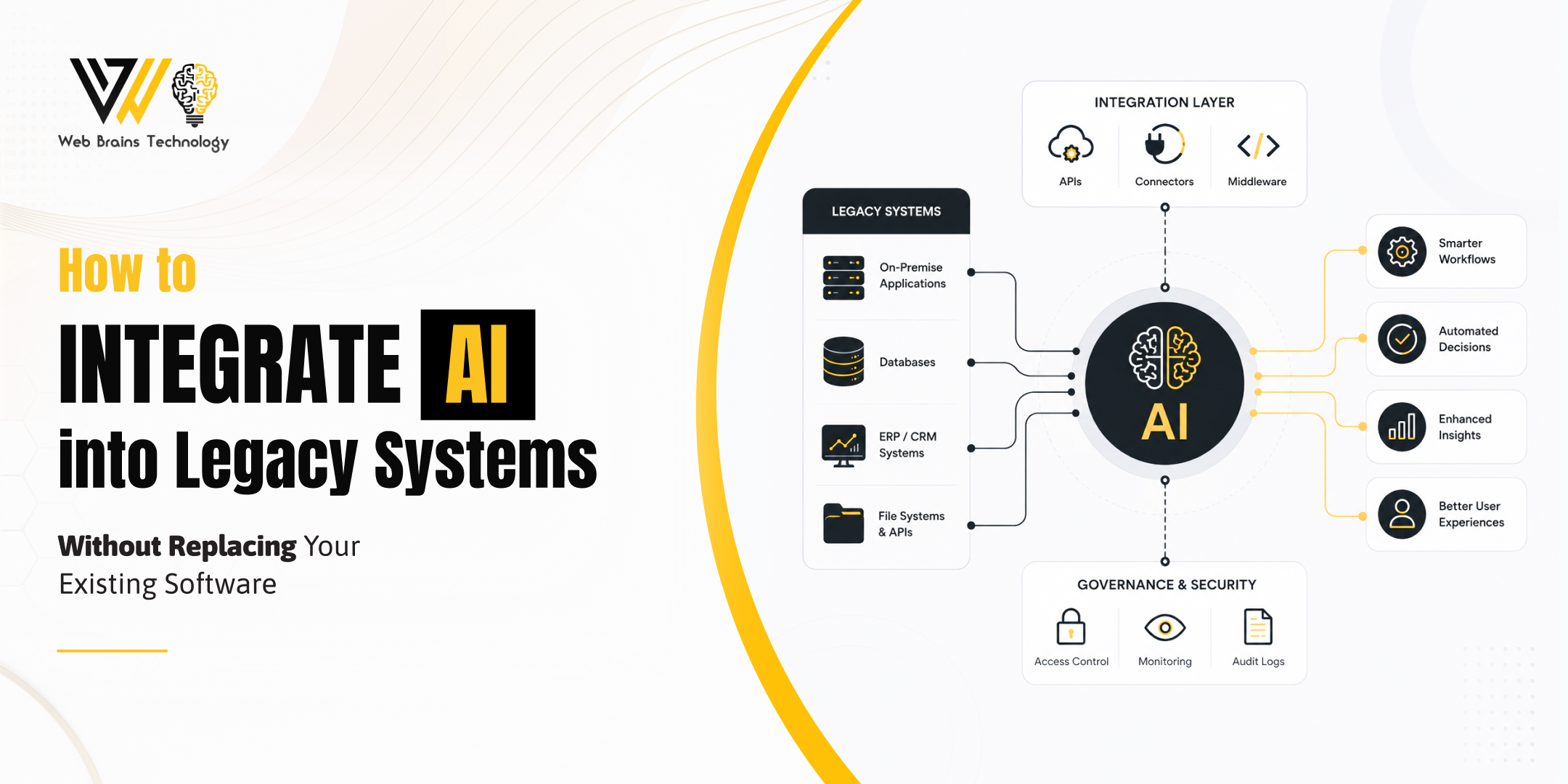
Instead of rebuilding your software from scratch, AI services can work alongside your existing infrastructure using technologies such as:
- APIs
- Middleware
- Machine learning models
- Large Language Models (LLMs)
- AI Agents
- Predictive Analytics
- Intelligent Automation
- Natural Language Processing (NLP)
This allows organisations to unlock new capabilities while continuing to use the software they already trust.
For example, an Australian logistics company using a 15-year-old inventory system can integrate AI to:
- Predict inventory shortages
- Automate purchase recommendations
- Forecast customer demand
- Optimise delivery schedules
- Detect supply chain risks
The underlying software remains the same, but its capabilities become significantly more intelligent.
Why Australian Businesses Still Depend on Legacy Systems
Despite rapid advancements in cloud computing and AI, legacy software continues to play a vital role across many Australian industries.
Businesses have often invested years of development, customisation, employee training, and operational processes into these systems. Replacing them can introduce significant costs and business disruption.
Common industries still relying on legacy systems include:
- Financial Services
- Healthcare
- Manufacturing
- Government
- Retail
- Mining
- Construction
- Logistics
- Education
- Professional Services
Many of these platforms still perform their core functions reliably. The challenge isn’t that they’re unusable—it’s that they weren’t designed to support modern AI capabilities.
Why Rebuilding Existing Software Isn’t Always the Best Choice
Many business leaders assume adopting AI means replacing everything they currently use.
In reality, complete software redevelopment often introduces unnecessary complexity.
Some of the biggest challenges include:
High Development Costs
Building enterprise software from scratch can require substantial investment, particularly when multiple departments rely on the same platform.
Long Project Timelines
Large redevelopment projects often take months or even years before businesses see measurable value.
Business Disruption
Replacing familiar systems requires staff retraining, process changes, data migration, and operational adjustments.
Data Migration Risks
Moving years of business-critical information into new platforms always introduces potential security, compliance, and accuracy concerns.
Employee Resistance
Teams are often comfortable using existing systems. A complete replacement may reduce productivity during the transition period.
Instead of accepting these risks, Australian organisations increasingly prefer integrating AI into existing software while keeping core business processes intact.
Benefits of AI Integration for Legacy Systems
Adding AI to your existing applications provides measurable business value while reducing implementation risks.
Improve Operational Efficiency
AI automates repetitive administrative tasks that consume valuable employee time.
Examples include:
- Data entry
- Invoice processing
- Customer enquiries
- Report generation
- Email categorisation
- Workflow approvals
Employees can then focus on higher-value work requiring strategic thinking and customer engagement.
Make Better Business Decisions
Legacy systems often store vast amounts of valuable business data.
AI analyses this information to uncover trends that would otherwise remain hidden.
Businesses can use predictive analytics to:
- Forecast sales
- Identify customer behaviour
- Predict maintenance requirements
- Detect financial risks
- Optimise inventory
This enables faster, more informed decision-making.
Enhance Customer Experiences
AI-powered chatbots, recommendation engines, and intelligent customer support improve service quality without replacing existing CRM systems.
Australian businesses can provide:
- 24/7 customer support
- Faster response times
- Personalised recommendations
- Automated appointment scheduling
- Intelligent self-service options
This leads to higher customer satisfaction while reducing operational costs.
Extend the Life of Existing Software
Rather than discarding software that still performs well, AI integration adds new capabilities and extends its lifespan.
Businesses preserve previous technology investments while remaining competitive in a rapidly evolving market.
Increase Productivity
AI reduces manual workloads by automating repetitive processes across departments.
Examples include:
- HR onboarding
- Payroll verification
- Procurement
- Sales forecasting
- Document processing
- Compliance reporting
This can improve productivity while allowing existing teams to focus on higher-value activities.
Strengthen Competitive Advantage
Businesses that adopt AI earlier often gain significant advantages through:
- Faster decision-making
- Improved customer experiences
- Better operational efficiency
- Reduced costs
- More accurate forecasting
- Higher employee productivity
Rather than falling behind competitors, AI integration helps businesses remain innovative while leveraging existing technology investments.
How Much Does AI Integration Cost in Australia?
The cost of integrating AI into legacy systems depends on factors such as the following:
- Complexity of existing software
- Number of systems involved
- Data quality and availability
- Required AI capabilities
- Integration method (API, middleware, microservices, AI agents)
- Security and compliance requirements
- Custom development needs
Rather than focusing only on upfront costs, businesses should evaluate the long-term return on investment (ROI). AI integration can help reduce manual effort, support faster decision-making, improve customer service and increase operational efficiency.
For an accurate estimate, organisations should begin with a technical assessment of their current systems and clearly define business objectives before implementation.
Signs Your Legacy System Is Ready for AI Integration
Not every organisation needs a complete digital transformation. In many cases, existing software is an excellent candidate for AI enhancement.
Your legacy system may be ready for AI integration if:
- Employees spend significant time on repetitive manual tasks.
- Business reports take hours or days to compile.
- Customer enquiries overwhelm support teams.
- Decision-making relies heavily on manual data analysis.
- Existing software stores valuable historical business data.
- Workflows involve multiple manual approvals.
- Demand forecasting is inaccurate.
- Your software supports APIs or can connect through middleware.
- Leadership wants AI capabilities without replacing core systems.
If several of these challenges sound familiar, integrating AI into your existing software can deliver immediate operational improvements while avoiding the costs of full system replacement.
How to Choose the Right AI Integration Partner in Australia
Implementing AI into legacy systems is not just a technology project—it’s a business transformation initiative. The success of your AI integration depends on choosing a partner who understands enterprise software, cloud architecture, data security, and the practical challenges of modernising existing applications.
When evaluating AI integration services in Australia, consider the following factors.
Industry Experience
Look for a technology partner with experience delivering AI integration projects across industries such as healthcare, finance, manufacturing, retail, logistics, and professional services.
Industry-specific knowledge helps ensure the AI solution aligns with your business processes, compliance requirements, and operational goals.
Expertise in Legacy System Modernisation
Not every AI development company has experience working with older enterprise systems.
Choose a team with expertise in:
- Legacy software modernisation
- Enterprise application integration
- API development
- Middleware solutions
- Cloud migration
- AI implementation
- Custom software development
This combination ensures your existing software can be enhanced without unnecessary redevelopment.
Security and Compliance
AI systems often process sensitive business and customer information.
Your technology partner should follow best practices for:
- Secure API development
- Data encryption
- Identity and access management
- Australian Privacy Act compliance
- Industry-specific regulatory requirements
- Cloud security
Protecting your data is just as important as delivering AI functionality.
Scalable AI Solutions
Your business requirements will evolve over time.
Select an AI integration partner that designs scalable solutions capable of supporting:
- Future AI models
- Increased data volumes
- Business growth
- Multi-platform integrations
- Additional automation opportunities
Scalable architecture protects your long-term technology investment.
Ongoing Support and Optimisation
AI integration is not a one-time project.
Continuous monitoring, model improvements, system updates, and performance optimisation help ensure long-term success.
A reliable AI consulting partner should provide the following:
- Technical support
- Performance monitoring
- AI model optimisation
- Security updates
- Continuous improvement recommendations
FAQs
Can AI be integrated into legacy systems?
Yes. Most legacy systems can integrate with AI using APIs, middleware, microservices, or custom connectors. This allows businesses to add intelligent capabilities without replacing their existing software.
Do I need to rebuild my software to use AI?
No. In many cases, AI can be added to existing enterprise applications without a complete rebuild. The best integration approach depends on your software architecture, business goals, and technical environment.
Which industries benefit most from AI integration?
AI integration delivers value across a wide range of Australian industries, including healthcare, finance, manufacturing, retail, logistics, education, professional services, and government.
How long does AI integration take?
Project timelines vary depending on system complexity, data readiness, and the required AI capabilities. Simple API integrations may be completed relatively quickly, while enterprise-wide modernisation projects typically require a phased implementation.
What are the biggest challenges when integrating AI into legacy systems?
Common challenges include outdated infrastructure, poor data quality, integration complexity, cybersecurity requirements, and user adoption. These can be addressed through careful planning, technical assessments, and phased implementation.
How much does AI integration cost in Australia?
The cost depends on factors such as the complexity of your existing systems, integration methods, custom development requirements, data preparation, and project scope. A technical discovery phase is the best way to estimate costs accurately.
Why should businesses choose AI integration instead of replacing their software?
AI integration allows businesses to modernise existing applications, reduce costs, minimise disruption, preserve historical data, and accelerate digital transformation without the risks associated with a complete software replacement.
Conclusion
Artificial intelligence is transforming how organisations operate, but adopting AI does not mean abandoning the software that already supports your business.
By integrating AI into legacy systems, Australian businesses can unlock automation, predictive analytics, intelligent decision-making, and enhanced customer experiences while protecting years of investment in existing technology.
Whether your goal is to streamline operations, improve productivity, enhance customer service, or accelerate digital transformation, AI integration for legacy systems offers a practical and cost-effective path forward.
With the right strategy, an experienced implementation partner, and a phased approach, organisations can modernise their software ecosystem without the expense and disruption of rebuilding from scratch.